logo

The Gap

Oct 28th, 2025

The Case for Construction

Why the built environment is the scaffolding of human prosperity
We live in an era of abundance.
Goods are cheaper. Food is a fraction of what it once was.
Information and entertainment are more accessible then ever.

But there's a notable exception:
Places.
Places to live. Places to connect. Places to work and to create. To heal and to learn.

Why the exception?
Productivity. More specifically, the productivity gap.

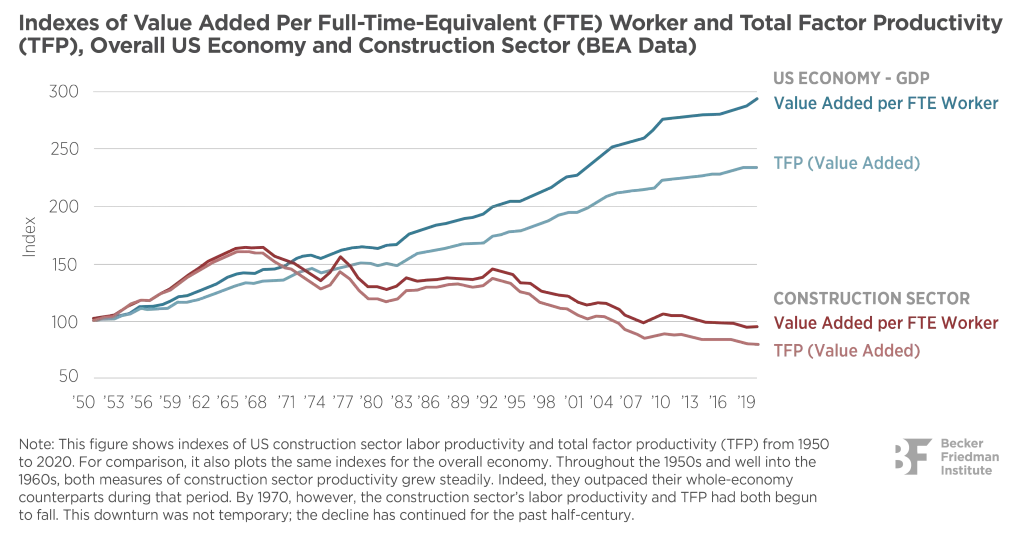
Since the 1950s, US productivity has seen unprecedented growth across nearly every sector.
Labor productivity has grown over 3x since 1948 with major gains across farming, manufacturing, retail, wholesale, computing, and more.

But one sector has not.
Construction.
Where output per worker remains stuck at mid-century levels (and has even declined since the 70s)

And this exception, has exceptional impact.
The built environment underpins every part of the economy.
It fuels our growth as a society.

If construction had kept even the half pace of other industries, the nation’s aggregate productivity, and individual incomes, would be 10% higher then they are today.

This is not just a problem for people in AEC.
It is a problem for all of us.
It's a bottleneck on human prosperity.

So how did we get here?
Why does this productivity gap exist in AEC?

That's what we'll be exploring with a series called The Gap:

  • How does land-use restrictions & regulation lead to smaller projects, smaller firms, and ultimately less R&D?

  • How does the unique nature of projects contribute to poor standardization and in-turn slow digitization?

  • How do decades of legal precedent & liability calcify the industry around traditional practices?

  • How does fragmentation & opacity slow decisions and delay project timelines?

  • How does a reliance on historic performance & long project lifecycles prevent new entrants from challenging the status quo?

  • And (a personal bugbear), how does cost-plus contracting reward bloated systems?

Interested in diving into these industry challenges with us? Follow along as we speak with builders, leaders, and upstarts looking to reverse this trend.

We live in an era of abundance.
Goods are cheaper. Food is a fraction of what it once was.
Information and entertainment are more accessible then ever.

But there's a notable exception:
Places.
Places to live. Places to connect. Places to work and to create. To heal and to learn.

Why the exception?
Productivity. More specifically, the productivity gap.

Since the 1950s, US productivity has seen unprecedented growth across nearly every sector.
Labor productivity has grown over 3x since 1948 with major gains across farming, manufacturing, retail, wholesale, computing, and more.

But one sector has not.
Construction.
Where output per worker remains stuck at mid-century levels (and has even declined since the 70s)

And this exception, has exceptional impact.
The built environment underpins every part of the economy.
It fuels our growth as a society.

If construction had kept even the half pace of other industries, the nation’s aggregate productivity, and individual incomes, would be 10% higher then they are today.

This is not just a problem for people in AEC.
It is a problem for all of us.
It's a bottleneck on human prosperity.

So how did we get here?
Why does this productivity gap exist in AEC?

That's what we'll be exploring with a series called The Gap:

  • How does land-use restrictions & regulation lead to smaller projects, smaller firms, and ultimately less R&D?

  • How does the unique nature of projects contribute to poor standardization and in-turn slow digitization?

  • How do decades of legal precedent & liability calcify the industry around traditional practices?

  • How does fragmentation & opacity slow decisions and delay project timelines?

  • How does a reliance on historic performance & long project lifecycles prevent new entrants from challenging the status quo?

  • And (a personal bugbear), how does cost-plus contracting reward bloated systems?

Interested in diving into these industry challenges with us? Follow along as we speak with builders, leaders, and upstarts looking to reverse this trend.